When people hear “Colombian coffee”, they often think of a classic, almost obvious origin. Yet behind that name lies one of the most complex and fascinating coffee ecosystems in the world. It is precisely this richness that convinced us at PICO CAFÉ to dedicate ourselves exclusively to this origin.
A coffee landscape unlike any other
Colombian coffee is closely tied to an exceptional territory. A large part of the producing regions is listed as a UNESCO World Heritage Site under the name Coffee Cultural Landscape of Colombia. This living cultural landscape brings together plantations, villages and human traditions in a mountainous area of the Andes.
« An exceptional example of a sustainable and productive cultural landscape that is unique and representative of a tradition that is a strong symbol for coffee-growing areas worldwide. It encompasses six farming landscapes, including 18 urban centres, on the foothills of the western and central ranges of the Cordillera de los Andes in western Colombia. »
– UNESCO (2011)
A mosaic of terroirs
Colombia has 32 departments, 23 of which produce coffee. This means that talking about “Colombian coffee” really means talking about a mosaic of climates, altitudes and soils. Between tropical valleys, Andean mountains and the microclimates created by altitude, each region develops distinctive aromatic profiles: floral, fruity, chocolatey or citrus notes. It is this natural diversity that makes it possible to explore a very wide sensory palette while staying with a single origin.
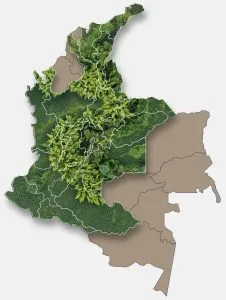
The so-called Colombian coffee zone, or Eje Cafetero (Coffee Cultural Landscape), in the centre of the country, includes the coffee regions of Caldas, Quindío, Risaralda and northern Valle del Cauca. However, the country’s coffee does not come only from this region: areas such as Antioquia, Cundinamarca, Boyacá and northern Tolima have conditions similar to the Coffee Cultural Landscape and also allow harvests almost all year round. In the warmer areas to the north and at lower altitudes — such as the Sierra Nevada de Santa Marta, the Serranía del Perijá, Casanare, Santander and Norte de Santander — coffees generally have a softer acidity and a fuller body. Conversely, coffees from the more southern regions such as Nariño, Cauca, Huila and southern Tolima, grown at higher altitudes and closer to the equator, develop a brighter acidity and a particularly sought-after sweetness.
In short, Colombia offers a diversity of coffees to satisfy every palate.
Colombian coffee: volume, quality and precision
Colombia is today the world’s third-largest coffee producer, behind Brazil and Vietnam. Each year the country produces around 14 million 60 kg bags of green coffee, close to 8% of world production; above all, however, Colombia stands out for the quality of its coffee. Unlike many other major producing countries, its production is almost entirely Arabica, a species generally considered finer and more aromatic than Robusta, which is grown in several tropical regions of the world.
In addition to the wealth of aromatic profiles resulting from the country’s geographic diversity, this specialisation in Arabica contributes greatly to the international reputation of Colombian coffee for its balance, aromatic complexity and clarity in the cup.
The harvesting method also makes all the difference. In some countries, strip picking is preferred: all the coffee cherries are removed from a branch at once, usually by machine. In Colombia, where coffee is often grown in mountainous areas, the most common practice is selective picking (cherry picking), which means harvesting only perfectly ripe cherries. Pickers go over each tree about every ten days, and a good picker can harvest up to 90 kilos of ripe red cherries a day — around 18 kilos of coffee beans.
Just thinking about it makes you want a coffee break.
Two harvests a year: a rare feature
Unlike many producing countries that have a single main harvest each year, Colombia generally enjoys two harvest periods:
- Main harvest: October to December
- Secondary harvest (“mitaca”): April to June
This calendar means coffees are available more regularly and are often fresher — a valuable advantage for roasters.
A human and well-organised industry
Colombian coffee growing relies mainly on family farms: an estimated 550,000 families make a living from coffee in the country, and much of the production comes from small fincas of less than 5 hectares, where harvesting remains largely manual and highly selective. This farming tradition goes hand in hand with an industry strongly structured around research and innovation. As early as 1938, the Cenicafé research centre was created by the National Federation of Coffee Growers of Colombia, with the mission of developing scientific solutions to improve the quality, sustainability and productivity of Colombian coffee growing.
Why this choice for PICO CAFÉ?
Beyond the figures and landscapes, our choice is also a human story. Colombia is a country where coffee is part of daily life, where every lot bears the imprint of a producer, a finca and a specific terroir. This traceability, diversity and human dimension correspond exactly to the vision we want to share.
At PICO CAFÉ, we have therefore made a simple choice: rather than multiplying origins, we prefer to explore a single origin in depth — Colombia — and showcase all its richness.
Because in reality, Colombia is not a single origin: it is a world of coffees.